
Design in India
Where design stands in India
Is India short of designers—or is the real question how much design its economy is ready to support?

India currently produces around 8,000 designers each year. Some argue that this is not enough for a population of 1.45 billion, and that the country should produce many more. But is the real issue the supply of designers? Let’s look at what creates demand for design in the first place.
Design is not isolated
The design industry does not exist in isolation. Broadly speaking, designers shape products and influence decisions inside companies, but they rarely make the final business calls. To do that, they would need to become entrepreneurs themselves and build design-led companies.
The quality of design, the quality of design education and even the number of designers are influenced by what industry needs. Those needs are shaped by larger economic forces.
- Per-capita income
- Supporting infrastructure and ecosystems
- Manufacturing capability
The number of designers in India
This is not only about supply. It is about demand.
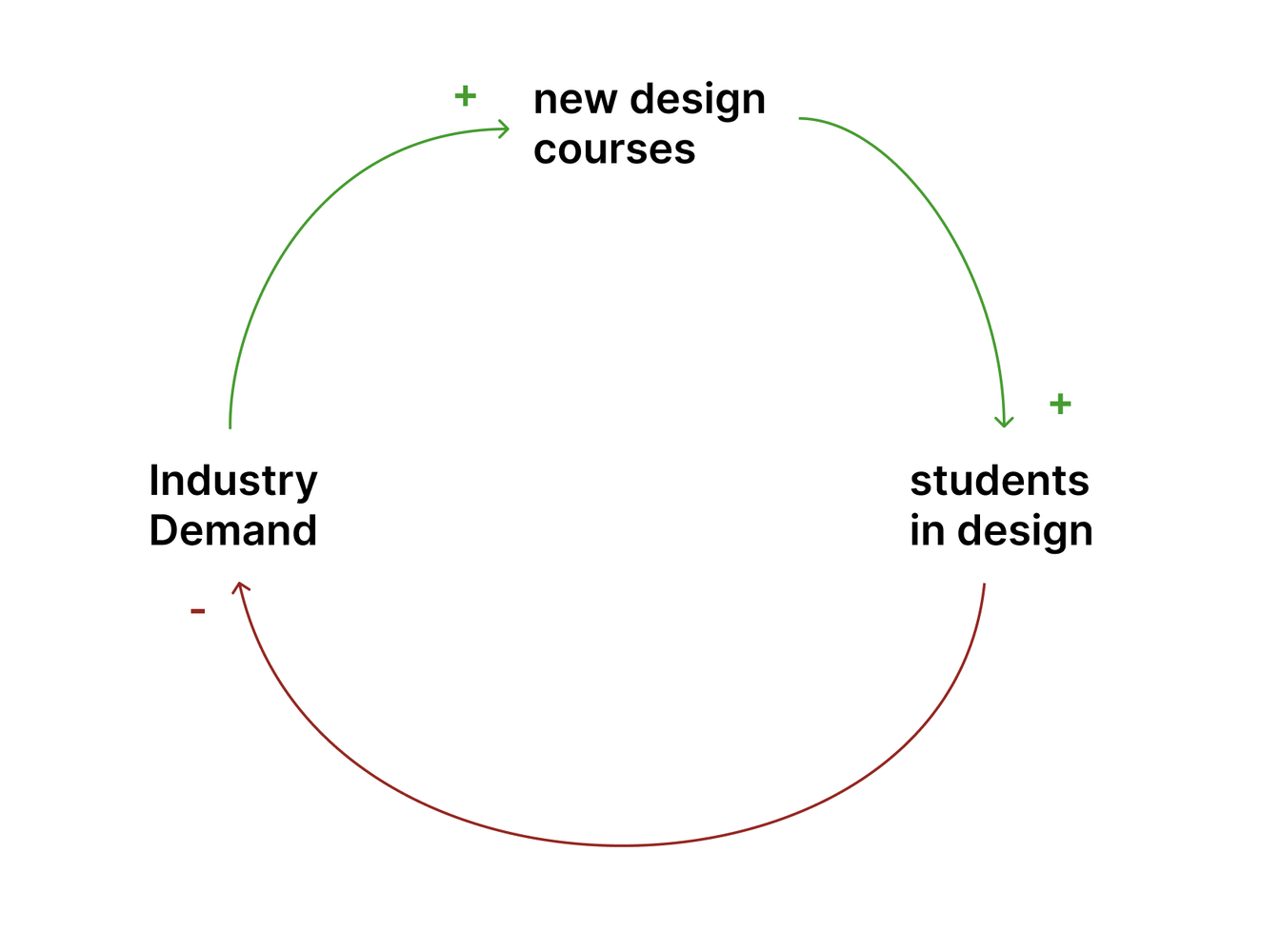
The number of designers graduating each year is directly influenced by demand from industry. In a market-driven economy, demand comes first. When companies invest in design, institutes respond by starting new courses. When graduates find good jobs, more students feel encouraged to choose design.
The loop is simple: industry demand → new design courses → more students choosing design.
The addressable market for designers
Companies invest in design to stay relevant, innovate and offer customers better value. That is what creates demand for designers.
In India, design is still often treated as a “value addition.” A company can prove an idea, build an MVP and even begin to scale without a trained designer. Design often enters during the next iteration. This is common among MSMEs, while larger companies with deeper pockets can invest in research and development much earlier.
The issue is not simply awareness. Companies know the value of design and use designed products themselves. The more immediate constraint is capital. Businesses prefer to stay lean, then hire designers and invest in research as their markets mature.
That investment raises product costs, so it makes sense only when enough customers can pay for a better product or service. Their ability to pay depends on the prosperity of the country and the size of its middle class.
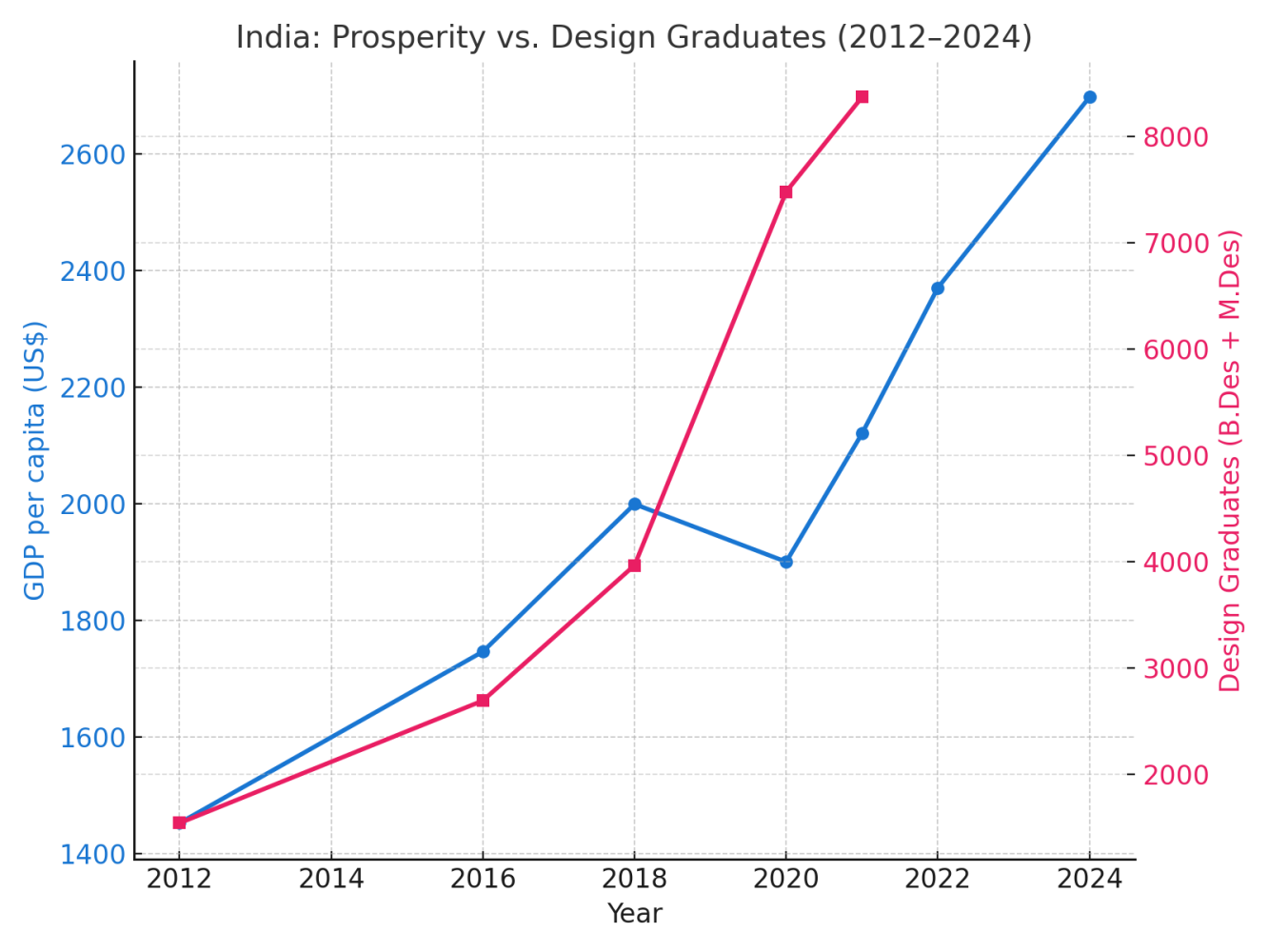
As India’s per-capita income has grown, a new middle-class market has emerged. Companies have invested more in design, and the number of design graduates has risen. The data suggests a strong relationship between income and graduate numbers, apart from the disruption of the Covid years.
This is the market that startups such as Swiggy, Zomato and many other Indian unicorns largely target.
The addressable market for design is closer to the top 30–40% of the population—the people able to pay for value-added products and services—not the entire population of 1.45 billion.
A timeline of brands and prosperity
The same pattern appears in the products and companies that emerged as India became more prosperous.
- Godrej introduces India’s first refrigerator in 1958; the Hindustan Ambassador launches; Hero Cycles begins in 1956.
- HMT watches and Bajaj scooters become household products.
- Nirma detergent and the Bajaj Priya scooter enter the market.
- Maruti 800, Onida televisions and Titan watches arrive.
- Liberalisation accelerates consumer durables from brands such as BPL and Onida.
- Flipkart is founded in 2007.
- Reliance Jio launches 4G services in 2016.
Each wave of prosperity created new markets—and design followed.
What explains lower design wages for new entrants?
Compare the growth of services and manufacturing and another pattern appears: manufacturing has not grown nearly as much as services over the past two decades.
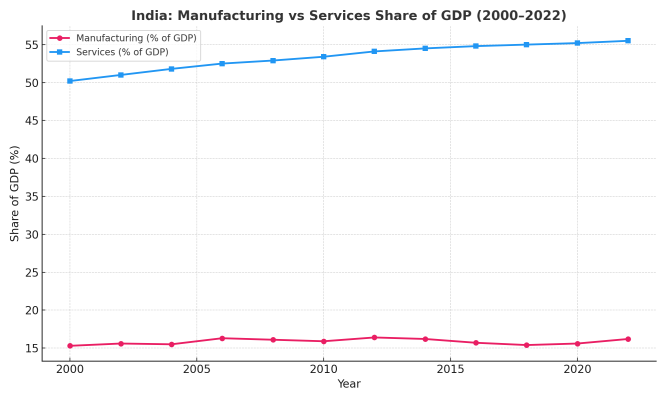
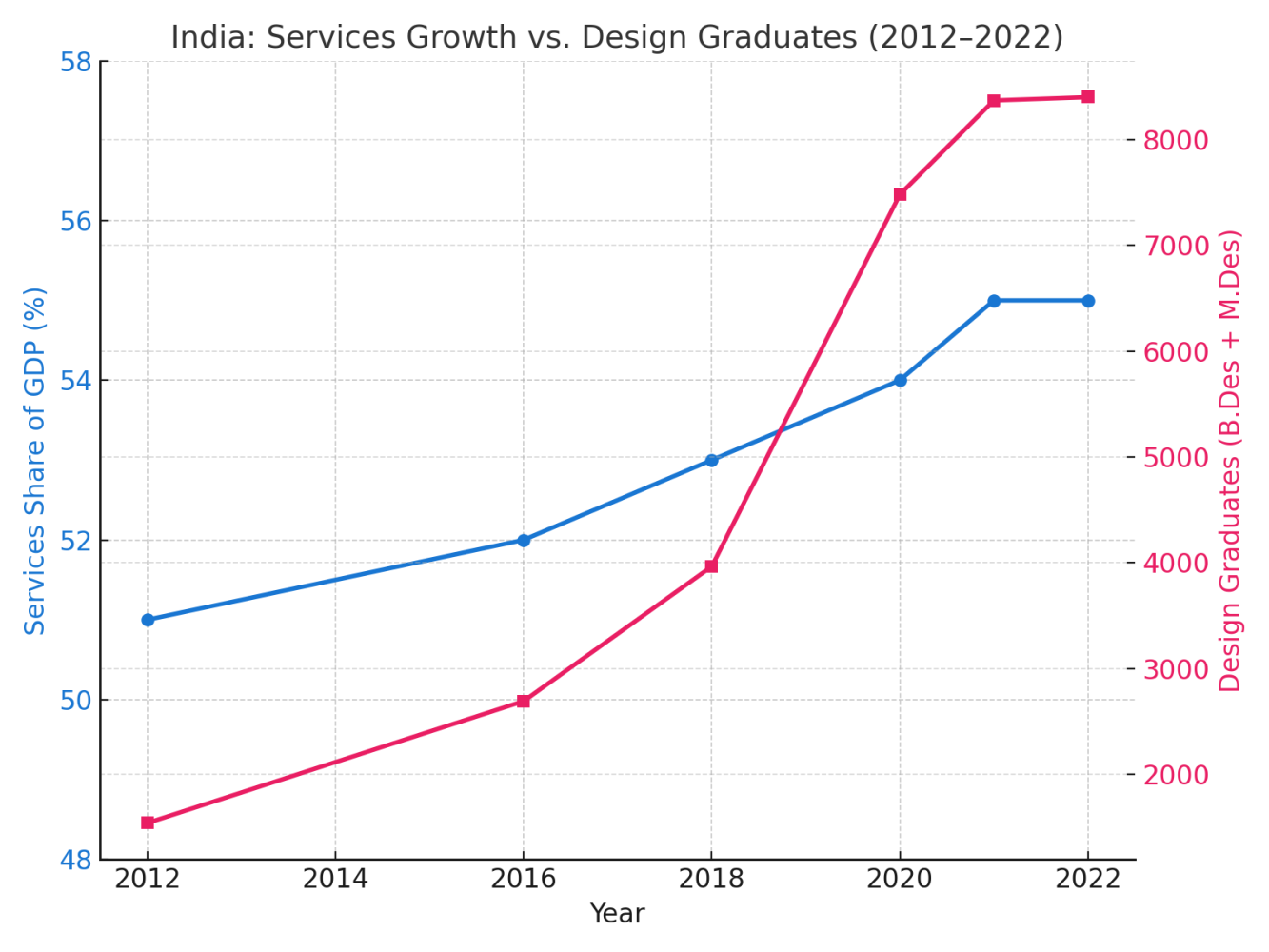
The boom in services—especially after the Jio revolution—created a surge in demand for UI/UX designers after 2016. More institutes opened design courses. After 2018, however, service-sector growth slowed through Covid and other business forces while the number of design graduates continued to increase.
Other industries did not grow quickly enough to absorb all of this talent. The result is more competition and lower wages for some fresh graduates and less-prepared candidates.
The case for industrial design
Industrial design has another constraint: it depends not only on demand, but also on manufacturing infrastructure.
Digital products thrive in India because much of the required infrastructure already exists—cloud platforms, software engineers and UI/UX designers. Hardware is more difficult. India is still developing the manufacturing depth, tooling expertise and supplier networks that industrial design needs to thrive.
This can change as India strengthens its manufacturing base through programmes such as Make in India. As that ecosystem matures, demand for industrial designers should grow with it.
Today, many designers move towards digital products because there are more roles and better pay. Industrial design still pays less than UI/UX in India, but a stronger manufacturing ecosystem can narrow that gap. I am experiencing this change first-hand as an industrial designer based in Bengaluru.
So, what’s next?
The data helps explain the present. But with AI now reshaping how we work, when might the next inflection point arrive—and how can designers prepare for it?
I tried to find an answer in the data itself.
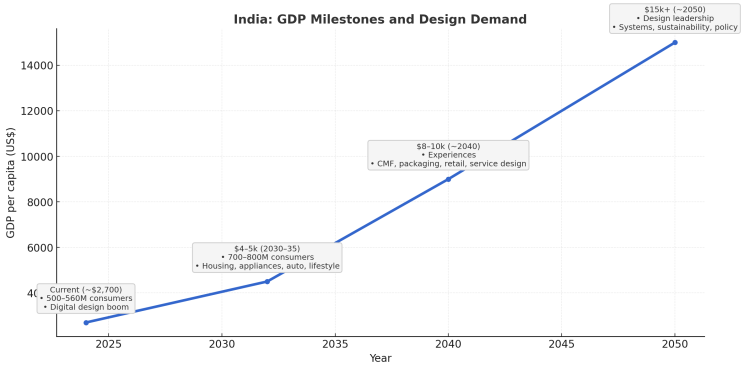
Current state
~$2,7002024- About 500–560 million Indians are in the consumer class—roughly 35–40% of the population.
- An earlier inflection point around $2,000 per capita helped digital design grow through smartphones and widespread internet access.
- Demand for UI/UX, app and service designers rose, and design education expanded with it.
Immediate inflection
$4,000–5,000around 2030–35- The consumer class could reach roughly 700–800 million people.
- Affordable housing, interiors, furniture, appliances, mid-tier mobility and lifestyle products are likely to grow rapidly.
- A broader middle class begins to expect design as a default—not an extra.
Next inflection
$8,000–10,000design sophistication- Consumers buy differentiated experiences, not only products.
- Demand grows for experience, service, CMF, packaging, retail and spatial designers.
- Local brands compete globally on aesthetics and usability, making strategic design more important.
Further inflection
$15,000+design leadership- Design becomes a core differentiator rather than a value-add.
- India can export design talent and thinking globally.
- Designers influence products as well as public services, cities, policy and governance.
The quality of design education
I am not an education expert, though I have taught once at a private design institute. I would not claim to identify every shortcoming in design education. From the data and my own experience, however, four priorities seem clear.
- 01
Quality follows demand
If industries demand stronger designers, education will adapt. Institutes want placements, and companies will hire when the quality improves. Scalable education models will emerge as industry expectations rise—but that does not mean we should wait to act.
- 02
Learning by doing
Design cannot be fully taught; it has to be learned through practice. Students need several projects, real feedback and time to build their craft. More industry experts in classrooms—and more transparency around placements and salaries—can reduce the gap between education and work.
- 03
Design + execution
AI is making execution faster and cheaper. Designers who can build a quick MVP, rather than only communicate it visually, gain more control and collaborate better. Combined with business education, this can also create the next wave of design-led startups.
- 04
More ties with MSMEs
Partnerships between chambers of commerce and design schools can connect students with MSMEs. Businesses learn how to work with designers, while students gain early exposure to real industry needs and constraints.

Conclusion
Design education is not failing. It is in transition.
Design is still often treated as a value addition. That is connected to larger structural conditions: policy, ease of doing business and the prosperity of the country.
But things are changing. As India becomes wealthier, design will play a stronger role in businesses and industries. Design needs a sizeable market to thrive. For now, the number of designers broadly reflects the size of the paying market; as prosperity grows, demand and supply should rise together.
There is another path too: designers can become entrepreneurs, building the products and services that shape industries and push them forward.
The question is not only whether India will need more designers. It is whether we, as designers, will be ready for the next wave.
